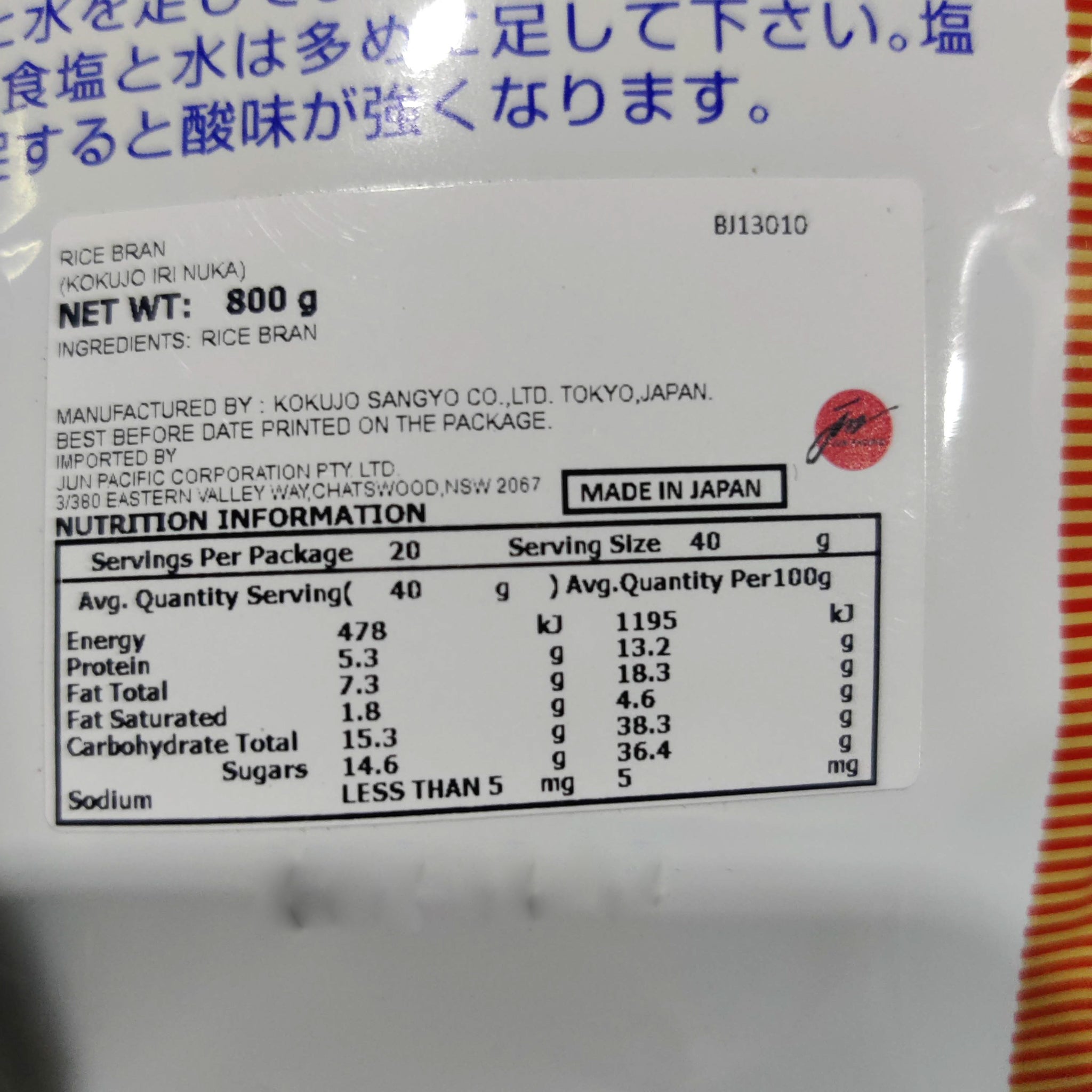
Kokujo Irinuka (いりぬか) is roasted rice bran for making a nukadoko — the living, fermenting bran bed that Japanese households use to pickle vegetables. In the maker's own words: "新鮮なぬかを風味よく焙煎しました" — fresh bran, roasted for flavour. Kokujo also states it suits takuan (pickled daikon). An 800 g bag, produced in Tokyo.
About Kokujo Sangyo
Kokujo Sangyo (国城産業株式会社) is a Tokyo company that has made roasted rice bran and pickling salt since it was founded in Bunkyo Ward in 1926, incorporating under its present name in 1964. It calls itself the originator of irinuka — 「いりぬか元祖」 — and works from Itabashi Ward in Tokyo.
What nukazuke is
Nukazuke (ぬか漬け) are Japanese pickles made in a nukadoko: a bed of rice bran mixed with salt and water into a paste, which ferments and both preserves and seasons whatever is buried in it. The bed is kept alive and reused, so it is tended rather than made once.
How to use & enjoy
Irinuka is the raw material for that bed rather than something eaten on its own — the bran is combined with salt and water, and raw vegetables are buried in the resulting paste to ferment into nukazuke. Cucumber, daikon and carrot are the traditional choices.
How to start a nukadoko — Kokujo's own method
The maker publishes this method for one 800 g bag:
-
You will need — one 800 g bag, about 800 cc of cooled boiled water, about 150 g of salt, a container, optional kombu or chilli (Kokujo does not recommend animal-based additions), and some high-moisture "discard" vegetables such as cabbage leaves or daikon leaves.
-
Make the bed — tip the bran and salt into the container and mix lightly, then add the cooled boiled water a little at a time, mixing well. Kokujo gives the target consistency as "about like miso".
-
Ferment it — bury the discard vegetables to get fermentation going. Depending on temperature this takes around a week. Replace those vegetables every two to three days and stir the bed once or twice daily; once it has fermented, take all of them out.
-
Then pickle — wash the vegetables well and drain them, rub them with salt and bury them in the bed. Wipe any bran from the rim of the container afterwards.
Important — please check the package label
While we make every effort to keep product information accurate and up to date, manufacturers may change formulations, packaging, allergens, ingredients, or specifications without notice. The actual product packaging is always the authoritative source. If you have specific concerns about allergens, ingredients, or any product detail, please contact us before purchase, or refer to the product packaging before consuming.
Roasted rice bran for traditional Japanese nukazuke · 国城の特選 いりぬか · Kokujo Sangyo pickling range.