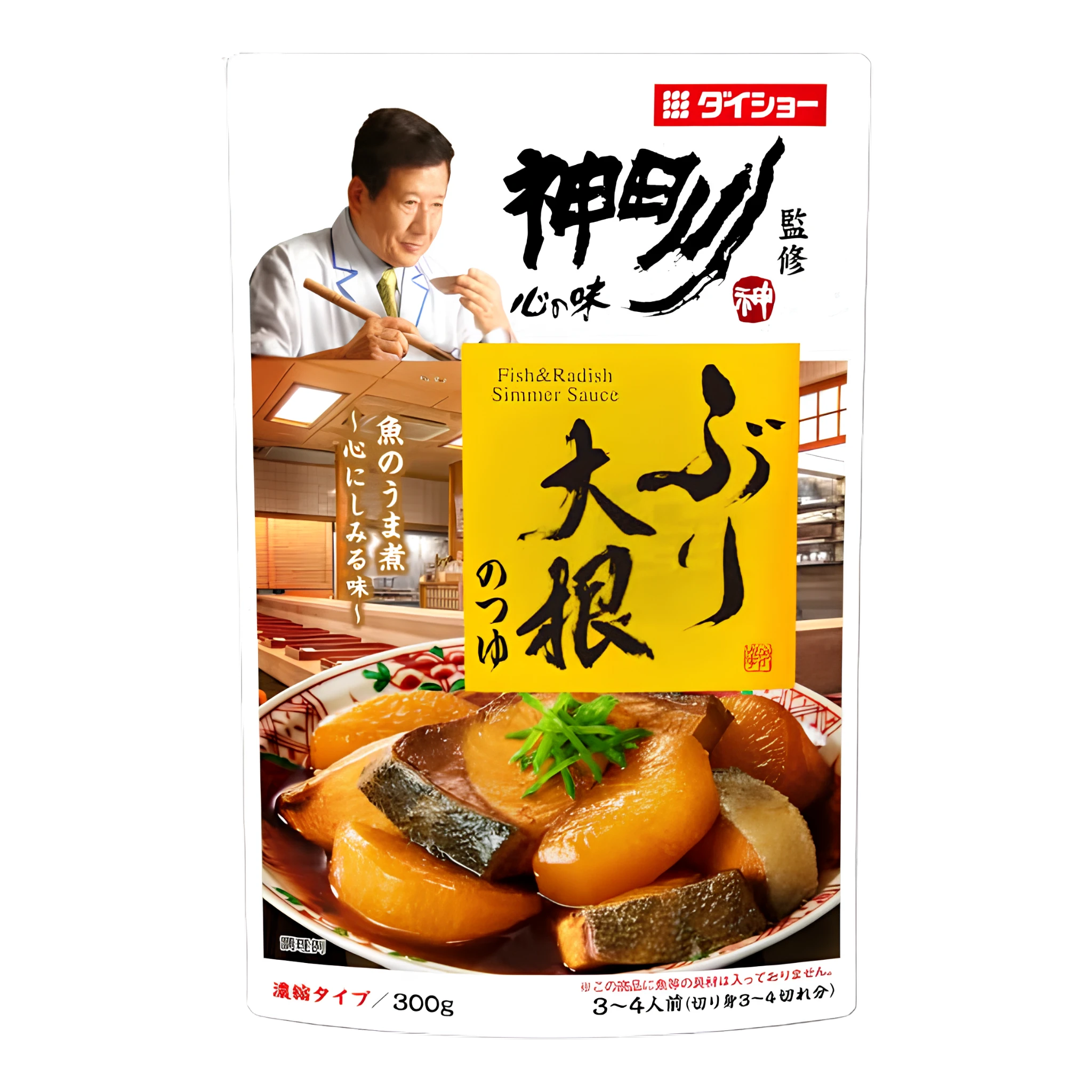
Daisho Kandagawa Buri Daikon no Tsuyu 300g is a ready-made simmering broth for buri daikon — the Japanese winter dish of yellowtail simmered with daikon radish. Daisho builds it on soy sauce, with the sweetness of sanon-to (three-times-refined) sugar and mirin and the flavour of junmai sake, then works miso through it as a hidden accent; the maker describes the result as koku-bukai, deep and rounded rather than sharp. One 300 g pouch seasons a pan for three to four people — the fish, the daikon and a cup of water are all you add.
About Daisho
Daisho Co., Ltd. (株式会社ダイショー) is a Japanese seasoning maker established in December 1966 in Fukuoka — originally as Daisho Foods, set up to make grilled-meat seasoning, and its very first product was a yakiniku sauce called Yakiniku Ichiban. It now works from dual headquarters in Tokyo and Fukuoka, and is known across Japan for yakiniku and steak sauces, seasoned salt-and-pepper, and nabe hot-pot soup bases, under the company motto "creating happiness through deliciousness".
Who is Kandagawa?
Kandagawa (神田川) is a Japanese restaurant group founded in 1965 in Kita-Shinchi, Osaka. Its founder, Kandagawa Toshiro, opened up a new style within a famously strict culinary world and became widely known in Japan through television, including Kandagawa Ryori Dojo and Iron Chef. The restaurants cook to his motto that "cooking is heart" (料理は心). This sauce is made by Daisho under Kandagawa's supervision (監修).
What is buri daikon?
Buri daikon (ぶり大根) is a classic Japanese home-style nimono — a simmered dish — in which yellowtail and thick rounds of daikon radish are cooked slowly together in a sweetened soy-based broth until the daikon turns translucent and takes on the flavour of the fish. It is winter cooking: both ingredients are at their best in the cold months, which is when the dish traditionally appears.
How to make buri daikon — Daisho's recipe
Printed by the manufacturer on the product page. Serves 3–4.
- Yellowtail (buri) fillets — 3–4 pieces (300–400 g)
- Daikon radish — half a radish (about 500 g)
- This product — 1 pouch
- Water — 200 ml (1 cup)
- Snow peas (kinusaya) to garnish — optional
- Sprinkle both sides of the yellowtail with a little salt and sake and leave for 15 minutes, then wipe away the moisture that comes to the surface with kitchen paper and cut each piece in half. Peel the daikon thickly, cut it into 2 cm half-moons, arrange them on a heatproof plate, cover loosely with cling film and microwave (500 W: about 7 minutes; 600 W: about 6 minutes).
- Put the daikon, this sauce and the water into a frying pan over a high heat. Once it boils, cover and simmer over a medium heat for about 10 minutes.
- Add the yellowtail, set a drop-lid (otoshibuta) directly on top, and simmer over a medium heat for about 10 minutes, stirring now and then.
- Once it is cooked through, lift off the drop-lid and reduce the cooking liquid to the strength you like. Serve with the liquid spooned over.
Daisho adds that pouring boiling water over the fish at step 1 removes more of its smell, that the pouch should be shaken well before it goes into the pan, and that lifting the yellowtail out before reducing the liquid helps keep the flesh from firming up. Simmering times are a guide — adjust them for the size of the fish and the daikon.
Ingredients
Soy sauce (produced in Japan), sanon-to sugar, junmai sake, miso, hon-mirin, ginger, hydrolysed protein, kombu kelp extract, processed soy sauce / thickener (xanthan gum).
Allergens
Contains: wheat, soy. The manufacturer declares no other allergen for this product — note in particular that although this sauce is made for cooking fish, it contains none; its only ingredient from the sea is kombu kelp extract. For the allergen declaration as printed for the Australian market, please refer to the product packaging.
Nutrition (per 1 serving, 86 g, as printed by the manufacturer)
- Energy: 46 kcal
- Protein: 1.5 g
- Fat: 0.9 g
- Carbohydrate: 8.1 g
- Salt equivalent: 2.0 g
Important — please check the package label
While we make every effort to keep product information accurate and up to date, manufacturers may change formulations, packaging, allergens, ingredients, or specifications without notice. The actual product packaging is always the authoritative source. If you have specific concerns about allergens, ingredients, or any product detail, please contact us before purchase, or refer to the product packaging before consuming.
Authentic Japanese simmered-fish sauce · 神田川監修 ぶり大根のつゆ · Daisho simmering-sauce range.