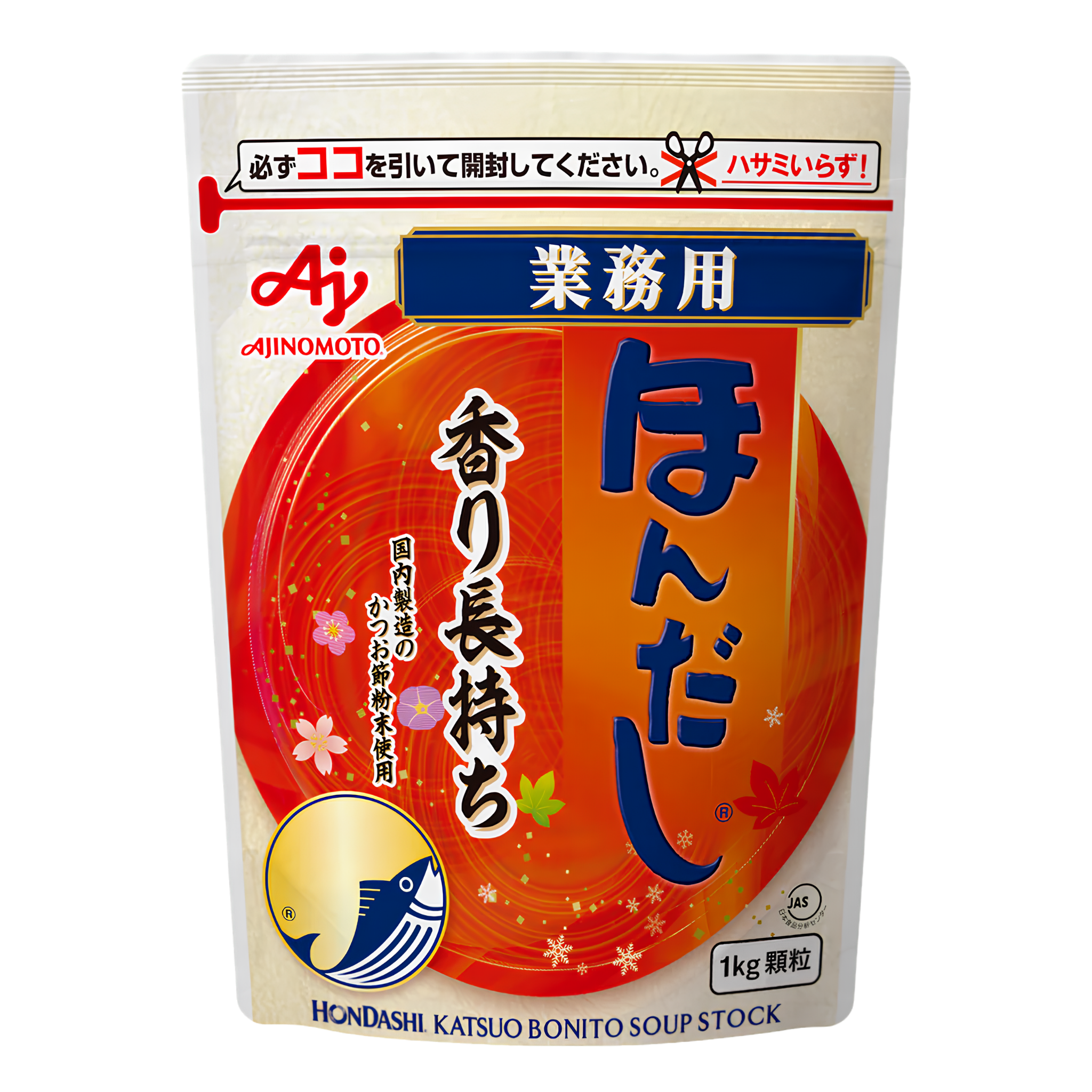
Ajinomoto Hondashi® bonito dashi, in the 1 kg foodservice bag. Ajinomoto co-develops it with traditional katsuobushi producers in Yaizu and Makurazaki, two of Japan's historic centres of bonito production, and the maker's own claim for it is that the robust bonito aroma and flavour hold up, so a dish still tastes right some time after it was cooked. Beyond straight dashi, Ajinomoto positions it as a depth-builder stirred into stir-fries and simmered dishes. It is a JAS-certified product, made at Ajinomoto Foods' Mie and Kawasaki plants.
Ajinomoto's own dosing guidance: 1 g (about ⅓ teaspoon, level) per 150 mL for miso soup and noodle broths, and the same 1 g per 150 mL for oden and hot-pot broths; about 6 g (2 level teaspoons) per serving for stir-fries such as vegetable stir-fry or Japanese-style yakisoba; and about 1 g per serving to round out simmered dishes such as curry.
About Ajinomoto
Ajinomoto (味の素株式会社) is one of Japan's foundational seasoning companies, founded 1909 by Saburosuke Suzuki II after Kikunae Ikeda's discovery of umami — the fifth taste — in 1908. The original Aji-no-moto (味の素, "essence of taste") seasoning launched in May 1909 as the world's first commercial umami seasoning. The portfolio now includes Hondashi (ほんだし) bonito dashi granules, the Cook Do® range of Chinese seasonings, Hi-Me (ハイミー) umami seasoning, and the Knorr-licensed cup-soup range.
What dashi is
Dashi (だし) is the savoury stock that underpins most Japanese cooking — most commonly made from katsuobushi, dried and fermented bonito shaved into flakes, often with kombu kelp. Traditionally it is brewed and strained; a granulated dashi like this one carries the same role in an instant, measurable form, which is why it is a fixture in both home and professional kitchens.
How to use & enjoy
Bonito dashi is the umami-rich liquid base for Japanese soups, clear broths and simmered dishes. It is the stock base for miso soup, and the broth base for noodle soups.
Ingredients
Salt (produced in Japan), sugars (sugar, lactose), flavour ingredients (bonito flake powder, bonito extract), yeast extract / seasoning (amino acids etc.). (Contains milk.)
Allergens
Contains: fish (bonito) and milk. Ajinomoto's Japanese declaration lists milk only; fish is declared here because the product is made with katsuobushi (bonito) and fish is a mandatory declaration in Australia.
Nutrition (per 100 g)
Energy 227 kcal · Protein 25.1 g · Fat 0.7 g · Carbohydrate 30.0 g · Salt equivalent 44.0 g.
Important — please check the package label
While we make every effort to keep product information accurate and up to date, manufacturers may change formulations, packaging, allergens, ingredients, or specifications without notice. The actual product packaging is always the authoritative source. If you have specific concerns about allergens, ingredients, or any product detail, please contact us before purchase, or refer to the product packaging before consuming.
Foodservice-grade Japanese bonito dashi · 「ほんだし」かつおだし · Ajinomoto Hondashi range.